10 Weird Animals
There are some very weird animals out there: here are ten found around the world including a fish with bright red lipstick, another sea-creature that can live forever, and a bird that is a dancing fiend.
Note: Featured image credit: “Red-Lipped Batfish“, Georgina Jones, CC BY-SA 4.0, via Wikimedia Commons

1. Wombats: Weird Poops & a Nobel Prize
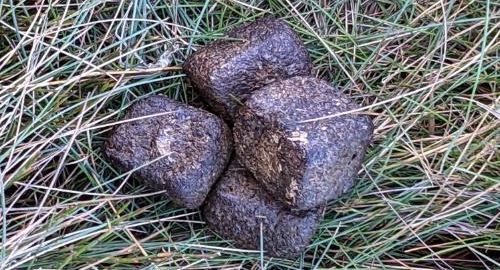

Wombats – like kangaroos – are marsupials, and native to Australia. What makes them weird animals is their poops: they’re cube-shaped. The shape is actually for good reason: wombats arrange these cubes to build walls, mark their territory, and attract mates. Imagine challenging one to play Tetris.
Nobody actually knows how they’re able to poop cubes. An adult wombat makes 80-100 cubes per night, and each cube is about 1″ on each side. That’s a lot of bricks!
Scientists have dedicated plenty of time to study this strange ability: the Nobel Prize for Physics in 2019 was won by Patricia Yang and David Hu who studied the wombat and its poo.
2. Red-Lipped Batfish: Suction Feeder
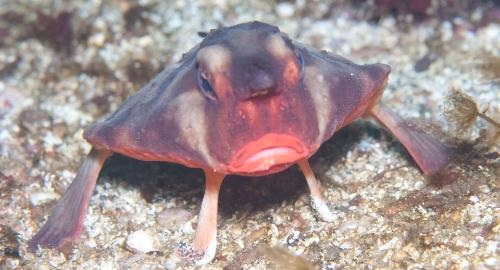

This fish – always ready for date night – lives at depths of 10-250 feet, and is a type of anglerfish. They’re not particularly good swimmers though, and instead they use their fins to “walk” across the seabed.
When the batfish reaches its mature form, its dorsal fin (the one on top of its body) becomes a spine-like projection, most likely to act like a lure for prey.
Reaching a length of 16″, the red-lipped batfish is known for its bright red lips. These may be for mating purposes though nobody is really quite sure. What is known is that the males do a dance and shake their heads to attract females. The two then dance together before laying eggs that stick to the ocean floor.
It also has an interesting method of feeding. Since it can’t swim very well, it can’t chase any prey. Instead it expands its mouth to generate suction to draw in a lot of water. Any prey caught along with the water becomes dinner.
3. Platypuses – It’s Not a Weird Animals List Without Them
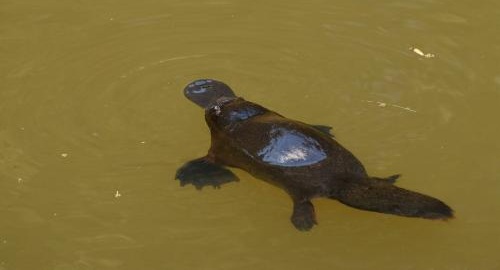

The platypus lives in Eastern Australia and Tasmania, and looks like what you’d get if you put a duck’s bill and a beaver’s tail on an otter. It’s such a weird animal that the first scientists to look at a preserved platypus body in 1799 decided that it had to be a fake, the result of parts from different animals being stitched together.
Not just weird to look at, the platypus also earns its spot on this list for being a mammal that lays eggs instead of live young. It’s not actually the only one to do so. Platypuses are a type of monotreme: mammals that lay eggs. The other members of this group are four species of echidna that basically look like a cross between an anteater and a hedgehog.
Monotremes are the patchwork members of the mammalian class apparently.
4. Guppies: The Opposite of Platypuses
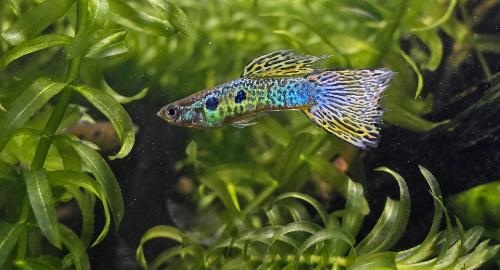

The opposite of the platypus: guppies are egg-laying fish that give birth to live young rather than eggs. The guppy isn’t the only one – there is a whole family called Poeciliidae which includes Mollies, Platies, and Swordtails.
These tropical fish were originally found from the Southeastern US to northern Argentina, but because of their popularity in aquariums and as a method of mosquito control, they can be found all over the world.
These fish also look a bit different to the usual, egg-laying fish: their anal fin is instead developed into a gonopodium which is used to transfer you-know-what into you-know-where.
5. [REDACTED] Snake: Not a Gonopodium But…
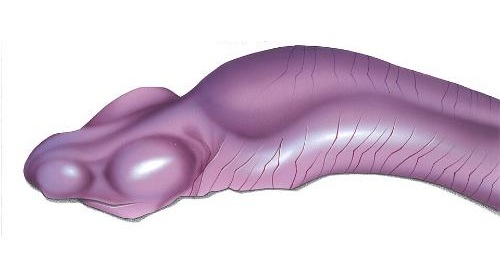

While we’re on that subject, let’s talk about the P*nis Snake, so named because of its resemblance to that particular piece of human anatomy. It isn’t actually a snake, but a caecilian, and is the largest tetrapod that doesn’t have lungs, growing over 2 feet long.
Quick aside: a tetrapod is a vertebrate with four limbs (or with an ancestor that had four limbs).
This animal – also named Floppy Snake – has no lungs and has features associated with lunglessness. It gets its oxygen from gas exchange through its skin. Not much is known about this weird animal, but it’s generally considered to be aquatic, and related to lungless salamanders.
6. Shoebill: weird animals Straight From your Nightmares
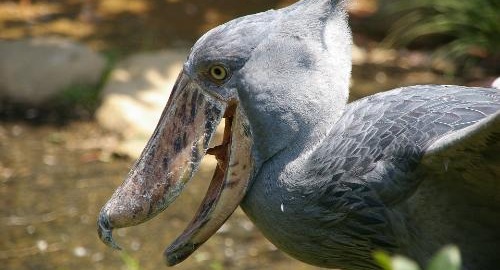

This enormous bird lives in East Africa and is named after its shoe-shaped bill. Unlike most birds that pleasantly tweet and twoo, the shoebill prefers to clatter its bill in a way that sounds just like a machine gun. The bill-clattering is apparently how these birds communicate, with adults and nestlings all going at it during nesting season. At least you’ll know to stay away I guess.
It also lets off a bloodcurdling screech – you wouldn’t expect any less from a bird that looks like it could kill you with one swipe of a foot.
It stands 43-55″ tall, has a wingspan of 8 feet, and its bill measures around 8-9″.
7. Immortal Jellyfish: Weird Animals That Can Live Forever
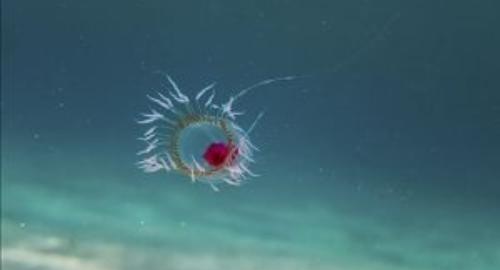

Call up all those billionaires spending millions on living forever: the Immortal Jellyfish does exactly as its name suggests. It has three life stages: larvae, polyp, jellyfish, and is able to revert back to the polyp stage when under stress, sick, or old. The polyp stage is a sort of colony on the seabed that hatches into more jellyfish.
In their mature medusa stage, they eat other species of jellyfish, seemingly with the goal of replacing all other jellyfish in the sea with themselves.
While theoretically the process of switching been polyp and jellyfish could go on indefinitely, these weird animals do actually die at some point: they are eaten by prey or they succumb to disease in the medusa stage before they’re able to revert back to the polyp form.
Back to the drawing board, billionaires.
8. Crescent-Shaped Lophorina: Tearing up the Dancefloor
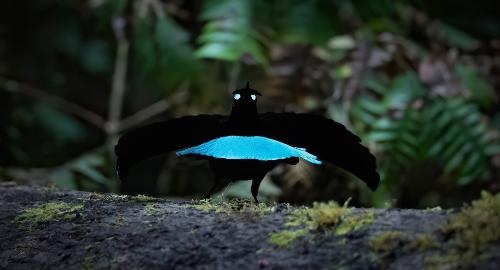

This small bird is about 10″ long. It’s a dimorphic species, meaning the male and female look different from one another: males are black with iridescent contrast feathers, females are reddish-brown. Usually found on treetops in Indonesia and Papua New Guinea, it eats fruits, insects, and frogs.
The female population is very low; this causes a lot of competition between males. Struggling to get a mate, the male birds have an elaborate courtship method where they first prepare a dance floor, then give a loud call to get a female’s attention.
As soon as one comes to watch, he spreads his feathers up and around his head, snapping his tail feathers against each other, while hopping around her. The female birds can be selective… rejected males need to try again, dancing for multiple females until chosen.
9. Thorn Bug: A Little Prick
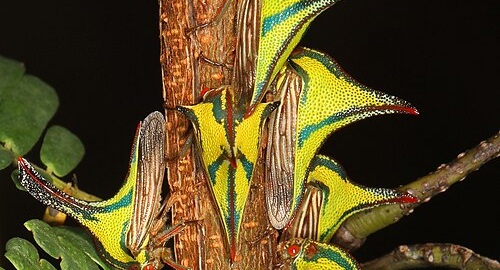

The Thorn Bug is a type of treehopper mostly found in South America. What makes it stand out is its horn which looks almost like the fin of a shark, or looking like a thorn on a rosebush. The horn sits on a plate (insects’ exoskeleton is made of plates) that is a mix of yellow, pale green, and red or yellow stripes.
Sitting on branches, they could pass for thorns and go almost undetected. They use their mouth parts to ingest sap from trees, and also lay their eggs within trees by making round holes to deposit them into. These colourful and weird insects can sometimes also be found in Mexico, southern Florida, and Central America.
10. Saiga Antelope: Weird Animals with great sense of smell?
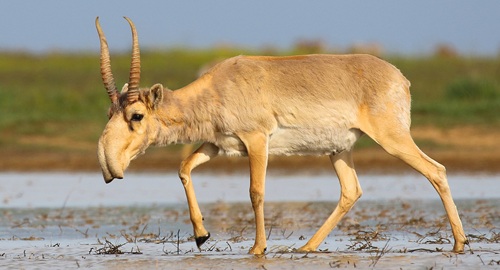

Look at that snout! Although it used to be found from Mongolia to the British Isles, nowadays the Saiga Antelope is only found in Russia and Kazakhstan, occasionally migrating to Turkmenistan in winter. There is also a Mongolian subspecies found only in western Mongolia.
The Saiga’s snout looks so strange because of its bloated nostrils that point downward, making it look like it could go sniffing for truffles. It also has a proboscis – an elongated snout. Add its long ears and you have an animal that looks both cute and kinda comical. Imagine if they could be trained like sniffer dogs at the airport.