What Does the Greenland Flag Look Like? (And 9 More)
First of all: is Greenland a country? Not exactly. It’s a self-governing territory within the Kingdom of Denmark, along with the Faroe Islands. However, it has its own parliament, its own language, and it’s very own Greenland flag, which, rather annoyingly, doesn’t use the colour green! Greenland is just one of many territories that aren’t sovereign*, and whose flags we tend to see less often. Here’s a closer look at the flag of Greenland, along with 9 others from non-sovereign places all over the world, including Zanzibar in Africa and Tokelau in Oceania.
*To be sovereign means that the area has supreme authority over its own territory and affairs, with no other state having the final say over its government.
Note: Featured image credit: Pexels.com/jerjer
1. Greenland
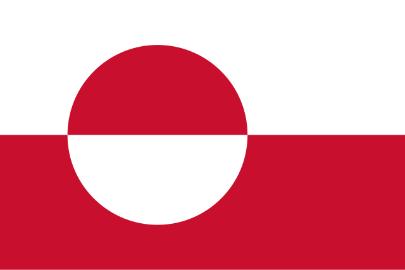

In 1973 the first flag for Greenland was proposed, a design in green, white, and blue. However the next year a newspaper asked for design proposals, with a committee eventually choosing the current red-and-white Greenland flag. Designed by Greenlandic politician Thue Christiansen, it was officially adopted in 1985.
According to Chrstiansen, the white stripe represents the glaciers and ice caps, the red stripe is the ocean, the red semicircle is the sun, and the white semicircle represents the icebergs. However that same year somebody noticed that his flag design was exactly the same as that of the Danish HEI Rosport rowing club, who graciously allowed for the design’s use on the country’s flag.
The flag is called Erfalasorput, which is Greenlandic for “our flag” by locals.
Odd detail: The Greenland flag is the only national flag of a Nordic country or territory that doesn’t feature a Nordic cross.
2. Isle of Man
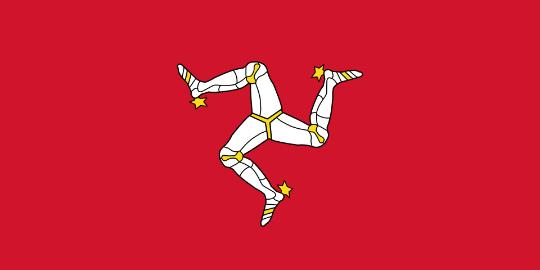

The flag of the Isle of Man (brattagh Vannin in Manx) features a triskelion – an ancient motif of a triple spiral. Here the triskelion is made of three armoured legs with golden spurs which are laid on a red background. It became the official flag of the Isle of Man in 1932.
The triskelion design of the flag is based on the Manx coat of arms which originated in the 13th century. Notably, the flag of Sicily also features a triskelion made of three legs. Historians believe that there is a connection between the two islands, and in fact, Edmund Crouchback, founder of the House of Lancaster, is connected to the Sicilian kingship.
Odd detail: Some molecules have a triskelion shape, including boric acid and triethylborane.
3. Tokelau
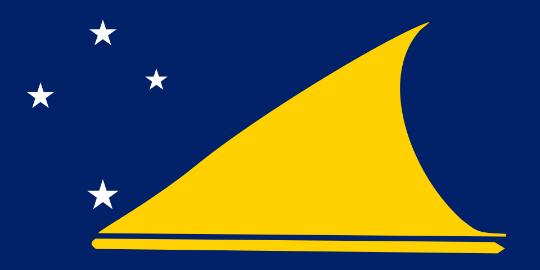

Tokelau is a dependent territory of New Zealand, and adopted its own official flag in 2009, having previously used the flag of New Zealand. Four white stars in the top left represent the Southern Cross, with a Tokelauan canoe sailing towards it. The canoe, according to the Tokelauan government, is a symbol of the country’s journey to finding the best method of governance for its people. The Southern Cross is a symbol of the help in navigating this journey.
Worth knowing: Tokelau produces 100% of its electricity through solar power, a goal achieved in 2012.
4. Easter Island
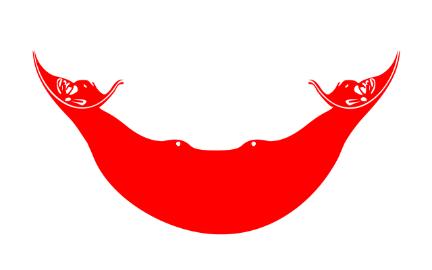

The flag of Easter Island (Te Reva Reimiro in Rapa Nui, the language spoken on the island) features a red reimiro: a crescent shaped ornament that used to be worn by the people of Easter Island. Its curve looks a bit like a Polynesian canoe, and it has a human face on each side.
This flag is not just representative of Easter Island: it also symbolizes the indigenous Rapa Nui people. In fact, the flag was first used by the Rapa Nui to unofficially represent the island, later becoming the island’s official flag in 2006. It flew alongside the national flag of Chile for the first time in May 2006.
Worth knowing: The islands got their name from their first known European visitor, the Dutch explorer Jacob Roggeveen, who found the islands on Easter Sunday 1722.
5. Midway Atoll
.svg)
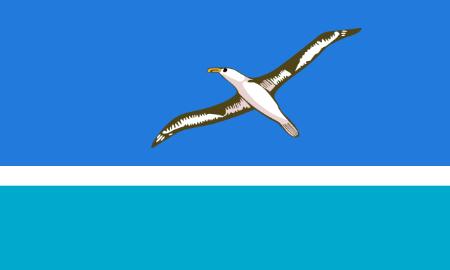
Midway Atoll sits approximately midway between North America and Asia, with whoever named the atoll being apparently far less imaginative than the person who came up with its flag. It consists of three islands, with only one being inhabited. The population of about 50 are employees of or contract workers for the US Fish and Wildlife Service. One of the company’s employees – Steve Dryden – designed the flag in 2000. It features three stripes: two blue (presumably for sea and sky) one white (seemingly to represent the land), and a bird flying above. Okay maybe not that imaginative.
Odd detail: Midway Atoll is closed to the public: tourism has not been allowed since 2013.
6. Wales
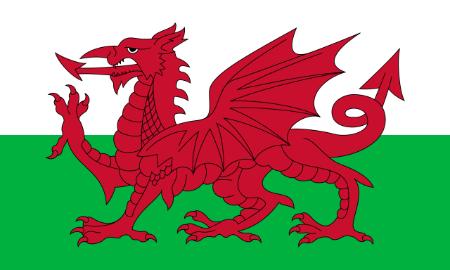

The flag of Wales is immediately recognizable from its red dragon design. It is called Y Ddraig Goch in Welsh: this means “the red dragon.” Direct! The dragon and the green and white colours derive from the Tudor family’s coat of arms. Henry VII in particular used the red dragon design.
The flag became official flag 1959. The dragon motif remains popular and features on the flag of Cardiff, a Welsh city, and Anglesey, an island off the northwest coast of Wales. Plenty of dinosaur bones have been found in Wales, building the case for the “dinosaurs-are-dragons” conspiracy theorists.
Worth knowing: Welsh mathematician Robert Recorde invented the equals sign (=) in 1557.
7. Christmas Island
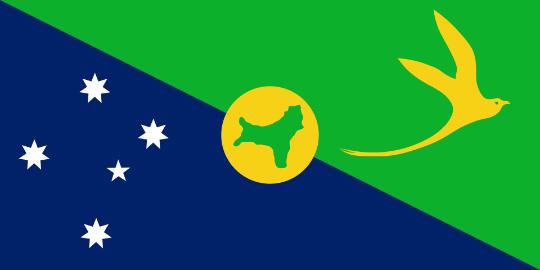

Christmas Island is an Australian external territory in the Indian Ocean. Its flag was designed by Australian Tony Couch who had worked on Christmas Island. He won a 1986 design competition to choose a flag for the territory. The flag design wasn’t officially adopted until 2022. Don’t cry foul just yet: Couch bad worked on Christmas Island, and his design was the winner of a 1986 design competition for the territory. The background of the Christmas Island flag is blue and green, with the Southern Cross constellation in the bottom left. In the top right, a golden bosun bird appears in yellow: this species is a symbol of the island. In the centre of the flag is a yellow circle with the map of the island in green.
Odd detail: Although the flag design was decided in 1986, the flag was officially adopted in 2002.
8. Gibraltar
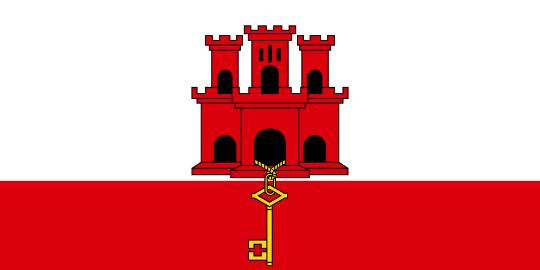

Gibraltar is a British Overseas Territory and city on the southern tip of the Iberian Peninsula, which is also home to Spain and Portugal. Gibraltar sits right near where the Mediterranean Sea meets the Atlantic Ocean. The flag of Gibraltar is based on the coat of arms of Gibraltar, which was granted by Queen Isabella I of Castile in 1502.
Odd detail: It is the only British Overseas Territory whose flag doesn’t feature the Union Jack in any form.
9. French Guiana
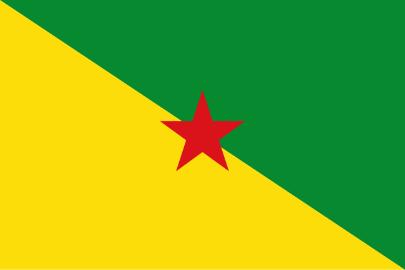

French Guiana is another entry that doesn’t have an official flag. However, since it is an overseas department and region of France, the French national flag is used when needed.
Located on the northern coast of South America in the Guianas and the West Indies, French Guiana has an unofficial flag that has become popular locally. It features a diagonal divide of green (representing the forest) and yellow (symbolizing gold). A five-pointed red star sits in the centre; it represents blood or socialism.
This unofficial flag was designed in 1967 by the Guyana Agricultural and General Worker’s Union and approved in that same year. Around 2007, the flat was adopted by the Departmental Council of French Guiana.
Worth knowing: Even though the flag is unofficial, it has been used by the French Guiana national football team.
10. Zanzibar
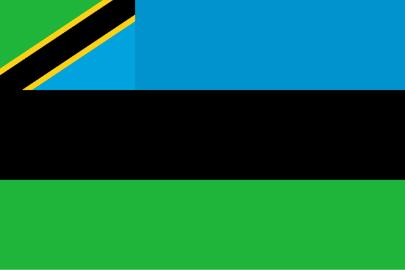

Zanzibar used to be a sovereign state, but in 1964 it united with Tanganyika to form the United Republic of Tanzania.
Located off the coast of East Africa, Zanzibar is made up of two large islands and many smaller ones. The flag was adopted in 2005: it is a horizontal tricolour of blue, black, and green; the national flag of Tanzania sits in the top left corner.
The country has had many flags throughout history. Two examples: as part of the Sultanate of Muscat and Oman in the 17th century its flag was a plain red field. In 1963, Zanzibar gained independence from the UK and added a green disc with two yellow cloves to the red field.
Worth knowing: Freddie Mercury was born in Zanzibar in 1946; at the time the country used the all-red flag.
The Flag of Greenland, and Others
Whether you’re into vexillology (the study of flags) or not, these are some interesting flags that are less commonly seen, as they are either unofficial, very new, and belong to non-sovereign states. Quite a few are the result of design competitions which seems like a fair and democratic way to get a new flag design.